Wednesday, October 30, 2013

How should hops be prepped for winter?

Here and the ALE Lab we just carried out some final plant maintenance to get the hop yard prepped for winter.

We had left some vegetation in the field after harvesting back in August-September. We figured since we have first year plants this would be beneficial as the plants need their leaves to photosynthesize (create energy) to build up their roots systems.

Before we cut the plants down the field looked like this:


We cut the bines down to about 1-2 inches above ground level.


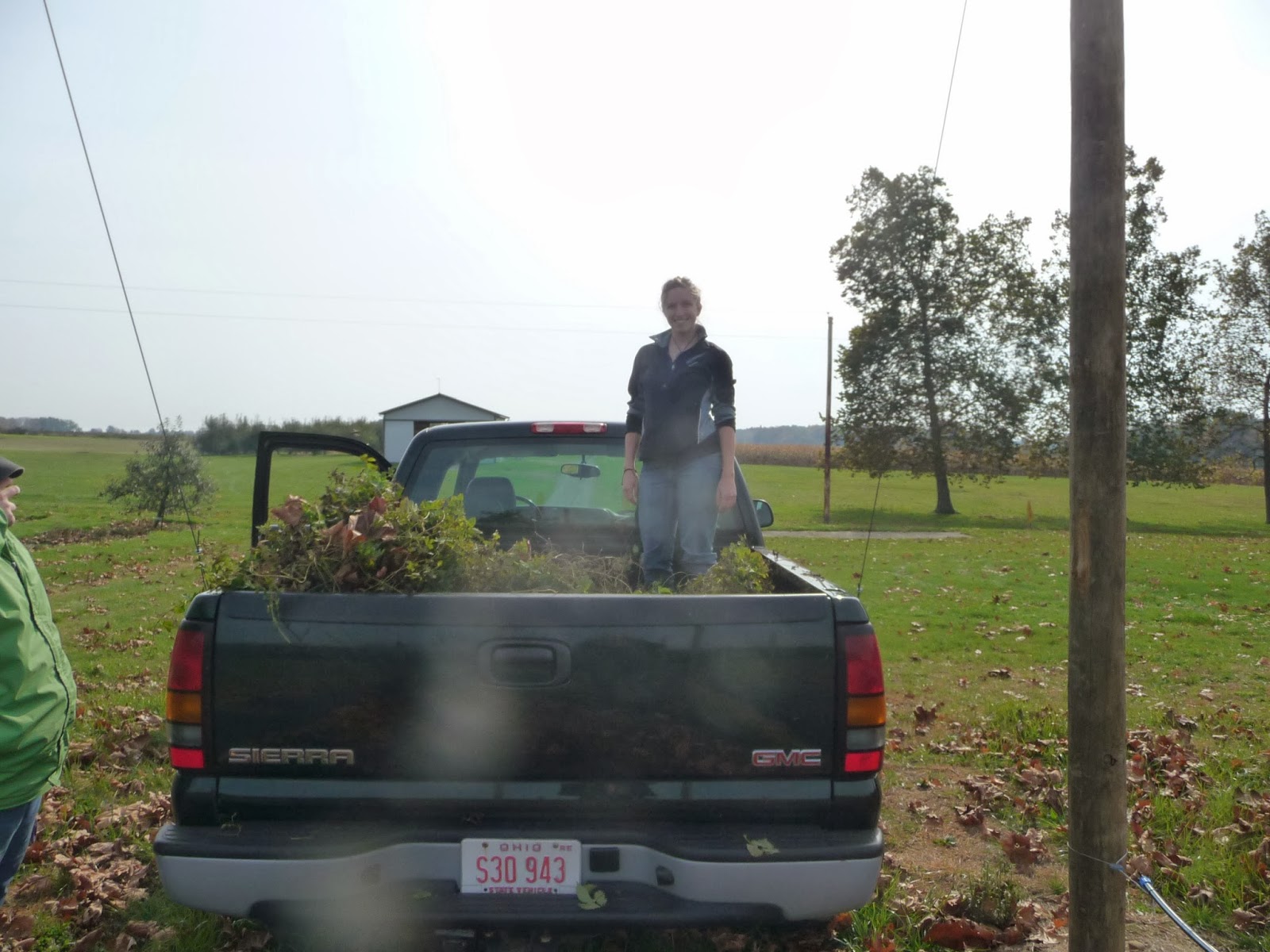
...I didn't take us too long to get the hop yard all cleared out!


Due to the presence of downy mildew we trucked all of the vegetation out of the field, and sent it to be composted.


Many growers will cover their hop plants with mulch or compost after cutting them back.  This is supposed to help protect the crowns from freezes. We decided to go mulch free to find out how that method would work for Ohio hop growers.


Friday, October 11, 2013

Finished my first week!

     Hey everyone! I figured since I have survived my first week in the ALE lab, it was time to introduce myself. My name is Nicole and in the attached picture is Cody. So what's my story? I was in the Navy for a bit, which is how I ended up with Cody. I was stationed in Italy first, then Spain and in Spain we had a kennel on base. It was love at first sight. Cody was about four or five months old when I got him and he's been with me ever since. I moved to North Carolina when I got out of the Navy and there I attended Queens University of Charlotte where I received my BS in biology. I am all set to graduate from Winthrop University, which is in Rock Hill, SC, in December with my MS in biology. If I had to throw a label on myself, it would be molecular ecologist. I really enjoy having a molecular component to my studies. My thesis research involved sampling amphibian populations at a local state park and testing them for the presence of Batrachochytrium dendrobatidis (Bd). Bd is a chtyrid fungus that infects the skin of amphibians and can cause the disease chytridiomycosis, which can be fatal in some species. I enjoyed my research and was very grateful to have picked up the skill sets I did, especially all the molecular work, while doing it as this was key to my being chosen as the new research assistant for the ALE lab.

     So what will I be doing here anyways? I was hired on to help with what we're calling the vacant lot study, which is the project Mary recently received an amazing grant for. I am very excited to be a part of this research and am looking forward to getting started on the project. The molecular aspect of the study will involve determining what some of the predators are eating. I hope to start testing protocols for that this winter so that we'll be ready when it's time to start collecting the selected specie and begin testing them. Working with arthropods is new for me and this roughly translates to reading, reading and more reading. Thankfully I actually enjoy learning about anything ecology related.

     Even though my first official work day was Monday, I attended the Stinner Summit last Friday with Mary, Chelsea, Andrea and Carol. It was a great introduction to the area and I loved the concept of the summit. The attendees work together to come up with projects that involve healthy agroecosystems and sustainable communities. There are numerous sessions in which attendees break off into groups to develop and explore an idea for a project by coming up with a mini-proposal that is then pitched to the other attendees and, at the end of the day, the attendees donate "Stinner bucks" as well as IOU's (can be for labor, expertise, money, etc.) to the projects they would like to support. The bucks are turned into funding through the Ben Stinner endowment. It was such a cool experience to see so many different groups of people come together and I think at the end of the day there were about six projects that received funding. My time this week has involved learning where to find things in the lab, learning pinning from Chelsea and Cali and yesterday I took my first trip into Cleveland to help Chelsea get soil samples for another project the lab is collaborating on. It's been a fun week and I am truly thankful that the opportunity to be a part of a lab with such a great group of people presented itself to me. I have had nothing but good feelings and excitement since I received the email from Mary saying that I had gotten the job and I know this will continue throughout my time here.

Friday, September 27, 2013

Polygonia interrogationis on hops

Among the many pests we discovered in our hop yard this year was the Question Mark Butterfly (Polygonia interrogationis). As late instar larvae they managed to completely defoliate an entire plant!


Of course since we are entomologists we saved the larvae in the lab to rear them into adults. The larvae are dark with bright yellow spikes

Herbert A. 'Joe' Pase III, Bugwood.org
The pupae are brown except for silver spots which can vary in size, but there are usually eight of them. They attach themselves to leaves with silk and hang there until adults emerge

Herbert A. 'Joe' Pase III, Bugwood.org
On the adult, the upperside of the forewing is red-orange with black spots. The underside is light brown and a pearly white question mark in center is often located in the center of the hindwing.


If this pest becomes a serious problem applications of Bt will control them. Please read and follow any pesticide label carefully.

Monday, September 23, 2013

Wooster Hops Production Field Day


Our Hops Production Field Day was featured by Farm and Dairy: Hops Article

Earlier this month we had a successful field day with about 80 participants! The excitement surrounding hop production in Ohio is growing and our job is to help growers obtain the knowledge needed to produce hops.


Monday, September 9, 2013

Emerging from the field!

You might have noticed a lack of posts recently! Here at the ALE lab we have been busy collecting data and samples from the field, driving miles and miles, planning and conducting field days, trying to avoid bee stings, and maintaining our sanity!

We have tons of great information to share with you from the summer which will trickle out in the form of various blog posts. For now we will leave you with some pictures highlighting our summer activities.

We held two workshops for the Buckeye Lady Beetle Blitz Program (BLBB)

Scott started some exciting experiments which involved tracking the movements of bumble bees.

Our hops grew tall...

...and we had a larger yield than expected!

Andrea's first field season was a success.

Our undergraduate intern, Denisha, conducted her project in Cleveland

We had a great canoe trip with the Herms lab.

We had 80 people attend our Hops Production Field Day in Wooster!

Wednesday, June 19, 2013

Sunny morning in the hop yard.

We checked out the hop plants in Wooster this morning and they  are starting so show some good vertical growth!


After our first week of pest sampling we have seen no sign of two-spotted spider mite (Tetranychus urticae) or hop aphid (Phorodon humuli). Michigan hop researchers and growers have reported signs of downy mildew in their fields (MSU hop update) and we are keeping our eyes open for signs of the disease as well.

Have a hoppy day!

Wednesday, June 12, 2013

Andrea's field work has begun!

Hello everybody!  My last post was way back in the fall when I joined the ALE lab as a new Masters student.  Things have been going great and I now have a project in the works.  I am interested in how landscape composition and management practices affect the natural enemies found in vegetable crops, specifically sweet corn and summer squash.  I am also sampling for long-legged flies (a type of predatory fly that is rather ubiquitous) to see if they can be a bioindicator group of the natural enemies in agroecosystems.


A long-legged fly (Charles Ray, Auburn University; Bugwood.org):


And now that summer is here, field work is officially under way!  I spent last week deploying traps at 16 field sites throughout northeastern Ohio.  The three types of traps I am using are pitfall traps (a cup of water in the ground with soapy water to keep the critters from crawling back out):


.... white pan traps (flies are particularly attracted to white):


... and yellow sticky traps (flying insects are attracted to the yellow card and get stuck in the sticky goo on the surface of the card):


 These three traps are clustered together at four plots within the crop:


This week I am going around to my sites again to gather the traps up and see what types of insects I caught.  Hopefully I got some interesting stuff; I shall keep everyone posted!