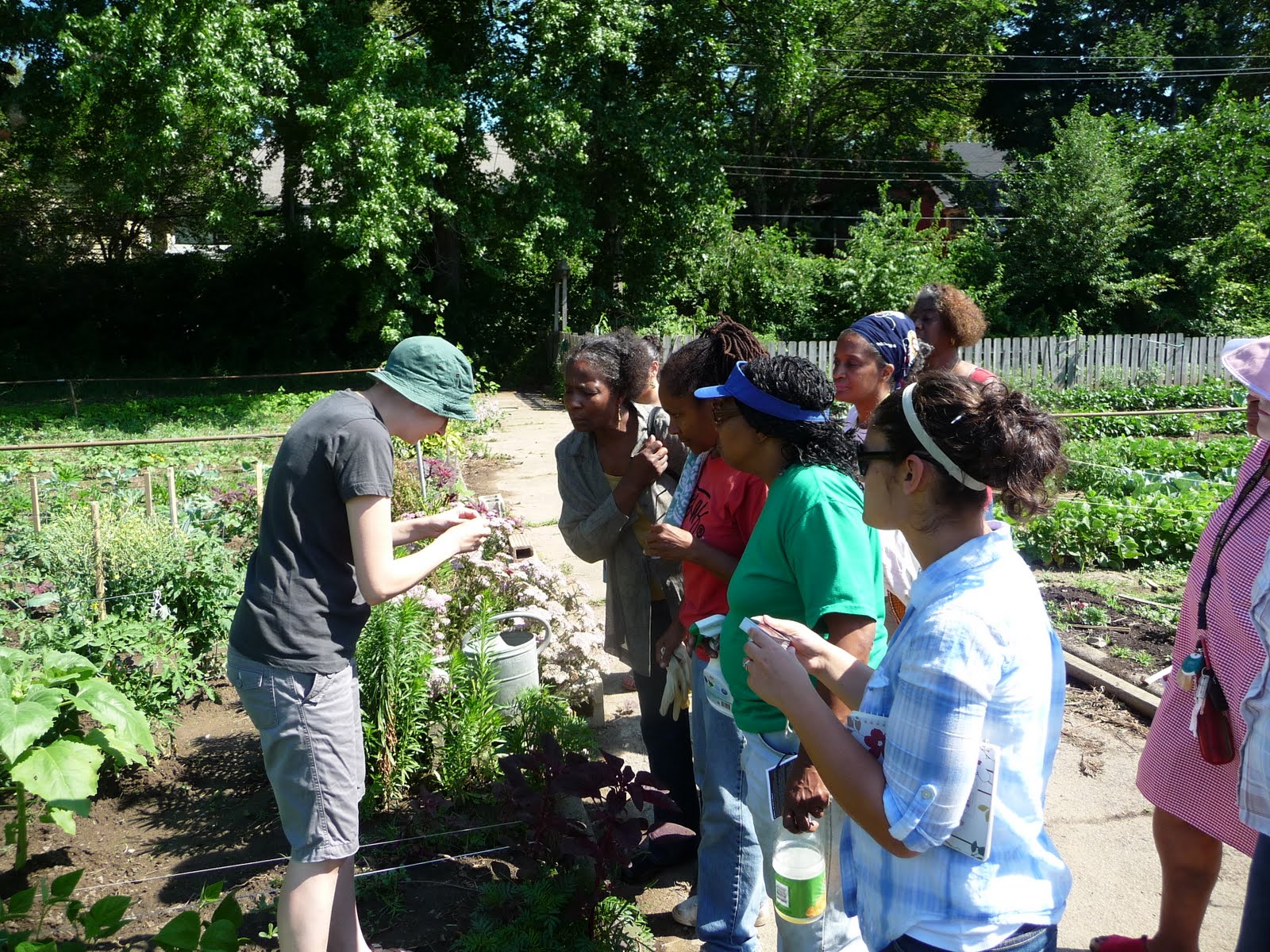
Scott and I traveled up to Cleveland last Saturday to meet with members of the Michael R. White Community Garden. We discussed biological control of key garden pests by enhancing natural enemy populations. Above, we examined squash plants for pests and natural enemies with the gardeners. Scott discussed the diversity of bees which provide pollination to garden crops. During our tour of the garden we saw several bees including squash bees, carpenter bees, honey bees and sweat bees. The garden is nearly 2 acres in size and was packed with a large diversity of crop plants and flowers!
Tuesday, July 13, 2010
What's Eating Your Garden?
Scott and I traveled up to Cleveland last Saturday to meet with members of the Michael R. White Community Garden. We discussed biological control of key garden pests by enhancing natural enemy populations. Above, we examined squash plants for pests and natural enemies with the gardeners. Scott discussed the diversity of bees which provide pollination to garden crops. During our tour of the garden we saw several bees including squash bees, carpenter bees, honey bees and sweat bees. The garden is nearly 2 acres in size and was packed with a large diversity of crop plants and flowers!
Friday, July 9, 2010
Pumpkin Sites
Here is a map of my pumpkin sites! After much wheeling and dealing, they are all finally locked in. Reds mark our floral strip farms, and greens mark our control farms. Each shape corresponds to a general surrounding landscape: squares are high agriculture, open circles are semi-wooded and X's are densely wooded. In time, I hope to post a little about each of them.
Carmella's farm is the red X in the NW corner of Wayne County. We also have another preliminary pumpkin site this year at the OSU South Center at the red X in Pike County. Why are six of my sites so far away you ask? Well, that's because the middle and western parts of Ohio are full of monocultured soybean, hay, corn and other commercial grasses like wheat. Due to certain glacial deposits and ancient fertile streambeds these are the most heavily producing areas, and producing heavily has been the tradition there for a long time. The growers we were looking for for this study were ideally smaller-scaled, and more diversified. As a result, some of these farmers work in far-off places, and so that's where we had to go. Extension agent, Brad Bergerfurd, helped us snag 5/6 cooperators in South Ohio who have participated in different studies before.
Interesting fact, two of my collaborators in South Ohio can be located on the front cover of the most recent Delorme's Gazetteer for Ohio. They are both on the same road; one north of Cynthiana and one just north of Rainsboro. I don't even have to open the book!
Carmella's farm is the red X in the NW corner of Wayne County. We also have another preliminary pumpkin site this year at the OSU South Center at the red X in Pike County. Why are six of my sites so far away you ask? Well, that's because the middle and western parts of Ohio are full of monocultured soybean, hay, corn and other commercial grasses like wheat. Due to certain glacial deposits and ancient fertile streambeds these are the most heavily producing areas, and producing heavily has been the tradition there for a long time. The growers we were looking for for this study were ideally smaller-scaled, and more diversified. As a result, some of these farmers work in far-off places, and so that's where we had to go. Extension agent, Brad Bergerfurd, helped us snag 5/6 cooperators in South Ohio who have participated in different studies before.
Interesting fact, two of my collaborators in South Ohio can be located on the front cover of the most recent Delorme's Gazetteer for Ohio. They are both on the same road; one north of Cynthiana and one just north of Rainsboro. I don't even have to open the book!
Thursday, July 8, 2010
Fresh goodies at the market
Fresh vegetables at one of the stands at the OARDC mid-week farmers market.
Did anyone get a chance to visit the OARDC farmers market this week? I stopped by on my way home yesterday. I like the "open-air" atmosphere of the market and the diversity of goods they usually have there. There were quite a few stands offering fresh farm produce ranging from tomatoes to sweet corn. My taste buds had a craving for some fresh strawberries yesterday, but too bad I missed out on them. Hopefully I can be there in time more next week. Besides farm produce, there were some delicious cookies and other treats as well.
Wednesday, July 7, 2010
Pollinator Habitat Management Course
I recently attended a pollinator habitat management short course in East Lansing, MI. It was held at the Rose Lake Plant Materials Center, which is part of the NRCS Plant Materials Program (http://plant-materials.nrcs.usda.gov/). At Rose Lake, plants are cultivated to solve conservation problems, including how to increase habitat for beneficial insects. Above is a trial of pollinator habitat that was just getting going this year.
While I was there I caught up with some old friends (Brett Blaauw, Julianna Tuell, Rufus Isaacs) who work with pollinator conservation and pollination ecology at Michigan State University (http://www.isaacslab.ent.msu.edu/Home.html).
We drove to one of the biofuel sites that the Isaacs lab is studying so I could check out the bumblebee hives. Many growers and gardeners buy bumblebee hives like this to increase pollination of their crops (http://www.koppert.com/pollination/). They are very easy to use, as they don't require maintenance like honey bee hives. You simply place a hive near your crops in the shade, and let them do their work! In the Fall, queens will emerge and overwinter alone, hopefully somewhere near your field. The rest of the bumblebees die in the winter, and you can remove the hive. This hive probably has about 200 bees inside. The lunch tray on top is a makeshift roof to protect the bees from rain and sun.
Here Brett is checking out some beneficial insect habitat that is further along. It's important for bees to have habitat to nest in and to forage in throughout the growing season. So it's always a good idea to have flowers blooming in your garden from early Spring into Fall. Be sure to keep up with Ben's posts for some info on how he's using floral strips in pumpkin.Friday, July 2, 2010
Flower power!
Fresh flowers (pumpkin, zucchini, squash, etc)
1 egg
Italian bread crumbs
Cooking oil
White cheese (optional)
Collect the flowers in the afternoon sometime after they have collapsed. These are dead flowers and they will never reopen. Refrigerate them until you're ready to cook, but they generally will not keep for more than one day because they are so moist. Rinse the flowers and make sure no bugs are inside! Crack the egg and breadcrumbs in separate bowls. Start heating the oil in a pan. Beat the egg into a uniform orange color and dip each flower individually. Cover the flowers in breadcrumbs one-by-one and put them all on the pan at the same time. Quickly flip them until golden brown on both sides. Add a layer of cheese to them as they cool and eat! You won't believe how much sweet summery flavor comes from the flowers.
This would be a great thing to do with kids because you can each man a station: dipper, breader, fryer and cheese-layer. Only adults and trained professionals should be the fryers, though! Next time I'm going to try putting the cheese inside the flower before dipping and breading.
Have a flower power weekend!
Thursday, July 1, 2010
Food for thought!
I know only a handful of people, myself included, who have it rough with environmental allergens, be it in-door or out-door. I'm told people who suffer a lot from allergies often have a sensitive immune response. Why do I bring this up? Here's why...
About two nights ago I was watching Jay Leno's "Late Night Show" on NBC. One of his guests that day is a host of some show on Animal Planet. Anyway, one of the topics they discussed caught my attention...sensitivity to allergens. Leno's guest told a story about a friend who was a serial sufferer of allergies, and was told by his doctor that he had a sensitive immune response, which was why he had all that trouble with allergens. One solution to fight that sensitivity, he was told, was to have tapeworms (Taenea spp) (yes you read that right...tapeworms!!) in his digestive tract. The logic behind it is that an infection of one's gut by tapeworms suppresses the overall immunune system of the host, thereby lowering the sensitivity to allergens. So, the friend of Leno's guest requested his doctor to deliberately infect him with tapeworms, which his doctor refused of course, because it would be unethical on the doctor's part. To cut a long story short, the guy found a way to infect himself. He doesn't suffer from allergies now according to the story.
The story got me thinking... I wouldn't want a tapeworm living in my digestive tract (albeit it can be seen as a mutualistic association in the story above). For the most part it is parasitic, not to mention it is a gross looking thing. I'm quite sure there a some healthier remedies once can find that can help. Does anyone know any good ones out there?
About two nights ago I was watching Jay Leno's "Late Night Show" on NBC. One of his guests that day is a host of some show on Animal Planet. Anyway, one of the topics they discussed caught my attention...sensitivity to allergens. Leno's guest told a story about a friend who was a serial sufferer of allergies, and was told by his doctor that he had a sensitive immune response, which was why he had all that trouble with allergens. One solution to fight that sensitivity, he was told, was to have tapeworms (Taenea spp) (yes you read that right...tapeworms!!) in his digestive tract. The logic behind it is that an infection of one's gut by tapeworms suppresses the overall immunune system of the host, thereby lowering the sensitivity to allergens. So, the friend of Leno's guest requested his doctor to deliberately infect him with tapeworms, which his doctor refused of course, because it would be unethical on the doctor's part. To cut a long story short, the guy found a way to infect himself. He doesn't suffer from allergies now according to the story.
The story got me thinking... I wouldn't want a tapeworm living in my digestive tract (albeit it can be seen as a mutualistic association in the story above). For the most part it is parasitic, not to mention it is a gross looking thing. I'm quite sure there a some healthier remedies once can find that can help. Does anyone know any good ones out there?
Sunflowers Version 2.0
So after our first debacle with our sunflowers (aka massive death), our second round is growing up nicely. With the help of Kojo, Nita, Bethany, Mark, Chelsea, Carolyn, and AJ (basically the entire lab), all 400 sunflowers have been successfully transplanted into pots where they will live out the rest of their lives as sentinel plants for our pollination study. We are really excited that they are healthy and will help us determine if pollination services are sufficient in the urban gardens and vacant lots of Cleveland. When they are starting to bloom I will be sure to share the view.
Subscribe to:
Posts (Atom)

