Tuesday, June 29, 2010

This is not an insect of the week!


Order Opiliones (Harvestmen)
aka: Daddy Long Legs

With two of my camera experiments completed, here at the Gardiner Lab we have been busy watching hours of video focused on lady beetle egg masses, eagerly waiting to see what would appear in the screen and start munching on the egg masses. We have been surprised to find that the top predator, in the video we have watched, has been Harvestmen. This was unexpected, and we still have tons of video to watch!

I have yet to find any literature that discusses harvest men as a predator of lady beetle eggs. They primarily prey on small insects, but they also scavenge, and feed on plant material.


Saturday, June 26, 2010

Students Help with BLBB Survey


Students from across Ohio help out with our annual lady beetle survey.

Top Picture: Student's participating in the Youth Garden display their sticky card. This garden is sponsored by the Men's Garden Club of Youngstown.

Bottom Picture: Students from Wilson Elementary School show off their school garden which also participated in the survey.

Friday, June 25, 2010

Breaking ground

This is Carmela Massaro, of Twin Parks Farms with her new puppy, Adelle. Her and her partner, Dean, farm over 800 acres of tillable land south of West Salem, and have been certified organic for 20 years. Their major crops are corn, soybeans and spelt (a low gluten relative of wheat). Her favorite part about farming is getting up in the morning before the rest of the world does. Raising row crops organically is all about mechanical weed control, and she says having equipment problems can be a major setback. Despite the busy row cropping, she is my most enthusiastic and open-minded collaborator. She's never grown pumpkins before, but has a small amount of acreage detached from the rest of her farm that she has generously donated for our experiment. Not only is she planting our pumpkins, but her secluded patch of land will be one of our floral strip sites as well.
This Thursday, Carmella, her farmhand, Mike, and I hand-planted about 400 seeds across 7 rows for our 2010 pollination experiment. Twin Parks is the first of two sites that we will be using this summer to polish our skills in the field before the large-scale experiments take place in 2011 and 2012. This is officially my first research site, ever. I hope it goes well!

Have a good weekend!

Thursday, June 24, 2010

Windstorms, thunderstorms, rainstorns, etc


Overcast skies in Ashland that eventually became a wind/thunderstorm mid-afternoon.

Unpredictable - that's what the weather forecast was like this past week. For instance, the forecast for this past Wednesday called for a high of 82 degrees Farenheit, with a 50% chance of rain...nothing about a storm of any sort to say the least. We were out taking down soybean pan traps and the weather in the Ashland/Richland area seemed perfect, only for it to turn completely upside down.

First, it felt like the temperature and humidity spiked up unbelievably around 1-ish. Then the sky became overcast in less than an hour. After a while strong winds picked up. I'm told that when wind blows and one is able to see the undersides of leaves then there is a likelihood of a storm. Anyway, this wind was strong, so strong that I had to use both hands to close the car door. No sooner had we pulled the last pan trap than the skies let loose! The storm that followed was so "thick"--one could hardly see five feet ahead--with tree branches flying in every direction. We had to pull over and sit in the vehicle for about 5 minutes to wait for adequate visibility to return before we could get back on the road.

Wednesday, June 23, 2010

Trial Run

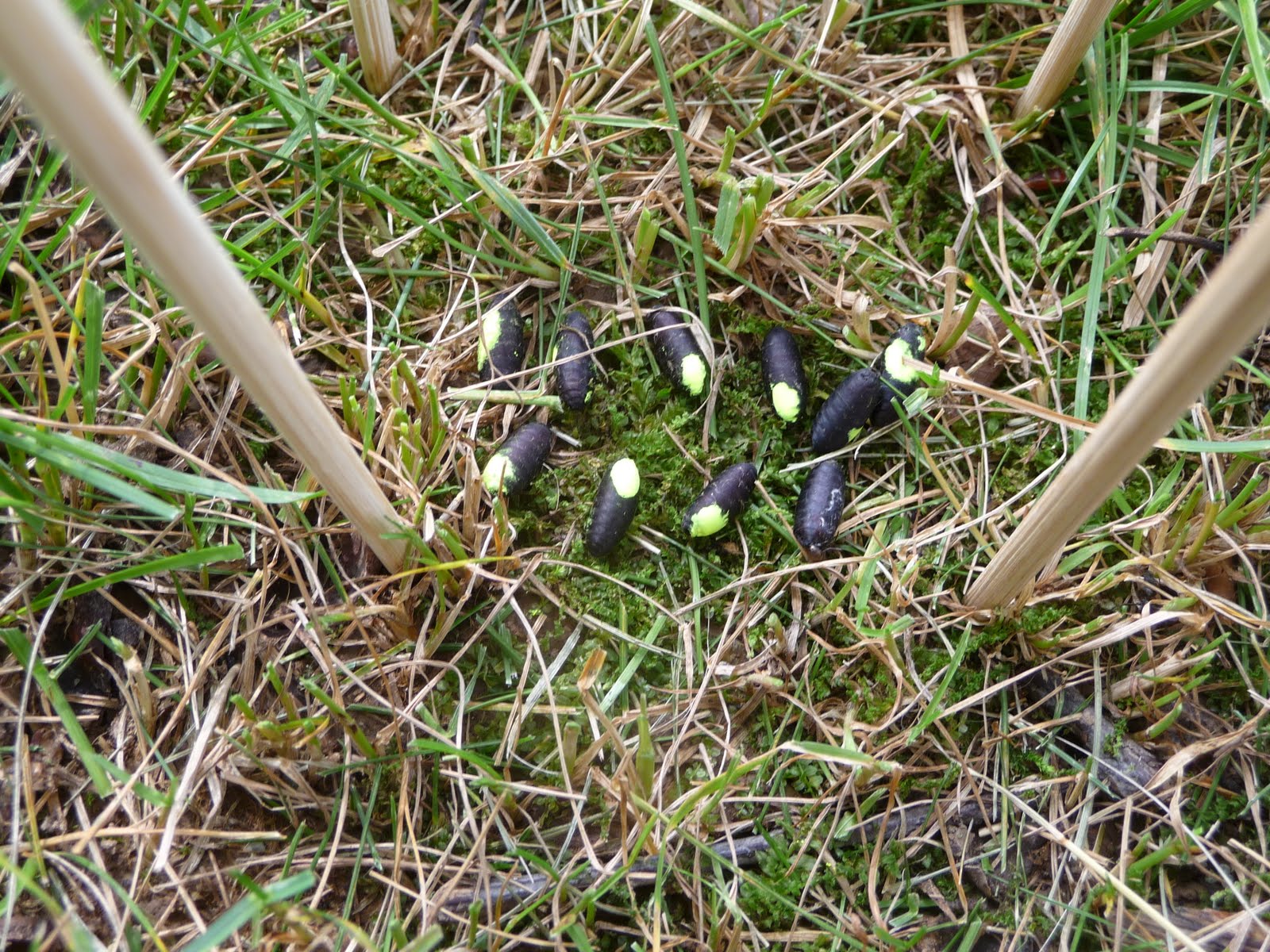
Sarcophaga pupae (light spots are paint added for visibility)

Flesh fly adult

We are getting ready to start our biocontrol service studies in the urban gardens of Cleveland. As part of these studies we will use Sarcophaga sp. pupae (above) as prey that ground predators such as ants and spiders will consume. Mary and I did a trial run yesterday outside the OARDC, and although I saw some ant activity, all the pupae are intact today. I guess we are lacking some biocontrol here at the entomology building!
If the pupae had been allowed to mature, they would become flesh fly adults. Flesh flies (Sarcophagidae) are very common and easily identified. Many have these characteristic gray and black stripes on the thorax, as well as a checkerboard pattern on the abdomen. Eggs are laid in dung, decaying animals, or sometimes in open mammal wounds. These flies provide valuable biocontrol services of their own, as the pupae decompose animal carcasses. Make sure you thank them for the lack of dead animals lying around!

Tuesday, June 22, 2010

Insect of the Week!


Karner blue butterfly
Lycaeides melissa samuelis
(Left: Female, Right: Male)

The Karner blue butterfly (KBB) is one of the few federally endangered insects in the United States. It's range used to stretch from New York to Wisconsin, and just reached into the Toledo area. The population of this species has now been scattered into small pockets, mainly due to the loss of their natural habitat (Oak Savannah).


The reason I decided to showcase this species this week is because it is the reason I decided to get into the field of entomology. I was lucky enough to have an internship with the Detroit Zoo which involved re-establishing populations of the KBB in Southern Michigan.


Programs such as this would greatly benefit disappearing native lady beetle species, such as the convergent, but there are currently no lady beetles on the endangered species list.

Monday, June 21, 2010

Urban Vacant Land Reserach

Our vacant land research project is underway! Cleveland has over 3,300 acres of vacant land and local citizen groups are looking at ways to re-purpose these former residential and commercial areas of the city. Several vacant lots have been transformed into community gardens. Our research is examining how the insect community changes when vacant lots are converted to urban farms. We are working on this project with a group of OSU and Cleveland State University scientists as part of an NSF-funded Urban Long Term Ecological Research Project Grant, awarded to our collaborator Mike Walton, CSU. Below are some photos from our first trip to the vacant lot and community garden sites.

Students arrive and collect data from a vacant lot site


Our community garden sites are managed by the Cleveland Botanical Gardens


At the end of the day, insect collecting traps were installed at 16 sites across the city. Kojo and Mark are carrying golf cup diggers, which they used to install pitfall cups. These cups are buried at the soil surface to survey for ground dwelling arthropods.