Wednesday, June 19, 2013

Sunny morning in the hop yard.

We checked out the hop plants in Wooster this morning and they  are starting so show some good vertical growth!


After our first week of pest sampling we have seen no sign of two-spotted spider mite (Tetranychus urticae) or hop aphid (Phorodon humuli). Michigan hop researchers and growers have reported signs of downy mildew in their fields (MSU hop update) and we are keeping our eyes open for signs of the disease as well.

Have a hoppy day!

Wednesday, June 12, 2013

Andrea's field work has begun!

Hello everybody!  My last post was way back in the fall when I joined the ALE lab as a new Masters student.  Things have been going great and I now have a project in the works.  I am interested in how landscape composition and management practices affect the natural enemies found in vegetable crops, specifically sweet corn and summer squash.  I am also sampling for long-legged flies (a type of predatory fly that is rather ubiquitous) to see if they can be a bioindicator group of the natural enemies in agroecosystems.


A long-legged fly (Charles Ray, Auburn University; Bugwood.org):


And now that summer is here, field work is officially under way!  I spent last week deploying traps at 16 field sites throughout northeastern Ohio.  The three types of traps I am using are pitfall traps (a cup of water in the ground with soapy water to keep the critters from crawling back out):


.... white pan traps (flies are particularly attracted to white):


... and yellow sticky traps (flying insects are attracted to the yellow card and get stuck in the sticky goo on the surface of the card):


 These three traps are clustered together at four plots within the crop:


This week I am going around to my sites again to gather the traps up and see what types of insects I caught.  Hopefully I got some interesting stuff; I shall keep everyone posted!

Friday, May 31, 2013

Hops yard progress...

All the posts are set, and our top wires have been installed!
 All that we have left for trellis construction is the bottom wire and the twine for climbing. The hops are certainly ready for some vertical growth.

Thursday, May 30, 2013

Controlling pests with flowers

Many researchers, including us (and more specifically: Ben), have been studying ways to control pests by attracting natural enemies to crops. Ben has tested floral strips which he planted next to his pumpkin plots, and one of the flowers he tested was sweet alyssum. While Ben has been busy writing his thesis...a study came out of Washington State University that tested the effect of sweet alyssum placed next to orchards. They found a significant decrease in the number of aphids in plots with the flowers compared to plots without flowers. For more info check out the article: www.sciencedaily.com: Controlling aphids with flowers

Ben will be presenting his results soon, and we are excited to see if he had similar results!


Tuesday, May 21, 2013

Hops Update

We've made some good progress in our Wooster hops yard.
 Most of the plants have leaves...
...and some of the plants are just emerging now.

The construction of our trellis system has started as well!

Holes have been dug...
...and posts have been "planted".


Friday, May 17, 2013

Asian lady beetle + microsporidia = Native lady beetle death!

As we've noted before in this blog, the decline of many native lady beetle species occurring in North America and other countries coincides with the presence of the Asian lady beetle, Harmonia axyridis. The mechanisms as to why this is the case have been unclear. Is Harmonia a more effective predator than natives? Is it merely eating the natives at a particular life stage (termed intraguild predation, and the topic of Chelsea's M.S. thesis)? Does it have a faster life cycle and therefore able to reproduce in higher numbers?

A new study published today in Science reports that H. axyridis may be such an effective invasive species due to microsporidia in its hemolymph. These microsporidia are safe for their hosts, but when native species (to Europe), such as Coccinella septempunctata, were injected with these microsporidia they died. In the field, this may mean that consumption of H. axyridis eggs is lethal to intraguild competitors.

C. septempunctata is also established in the U.S., and is a dominant competitor of our own native species. It will be interesting to see how these new findings will influence our understanding of American native lady beetle declines.
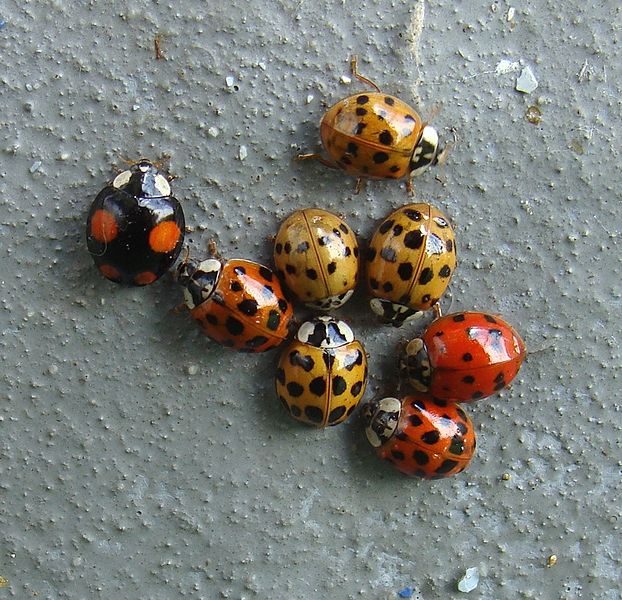
Harmonia axyridis (wikipedia) 
Report in Science (paywall): http://www.sciencemag.org/content/340/6134/862

Science Daily article: http://www.sciencedaily.com/releases/2013/05/130516142541.htm

Are you signed up for the Gardiner Lab Buckeye Lady Beetle Blitz training workshop?